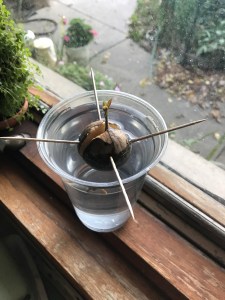
Over the past few months I have been growing an avocado tree. Its not a very time consuming task, mainly just making sure the plant has ample sunlight and water. In fact, growing the avocado tree has required such a small time investment that I grew frustrated about how little effort was required on my part. After some basic research I had to stick toothpicks in it and wait. Once planted, the tree sits on a sunny windowsill and gets water every few days. No routine walks, no lullabies.
 I’ve often wondered why we didn’t learn more about gardening and plants in elementary school. I spent a lot of time outside as a kid. However, it was not until I started growing Aloe Vera in my room as a teenager that I learned about how plants grow. Sure we took classes on photosynthesis and eukaryotic vs. prokaryotic cells. But we never learned about seed germination, or soil types, or all the interesting tidbits that come from actually having to deal with plants. Maybe where you are from is different, but it was not part of the curriculum here in Minnesota. We had a naturalist that told us about tree species in Elementary school, but I only remember her because she was mean. We did not have a dedicated garden or lessons on how tomatoes form. It seems to me that this was a mistake on the part of the school administration. It would not have taken a large amount of time or effort to teach some kids how to plant a tomato garden and then check on their growth weekly. Granted this growth would occur over the summer, so if we are not in school, then there are no students witnessing the growth. I still think it would have been better to plant seeds in may, have school end, and then come back in the fall to see a garden. The teacher could explain what happened and this could stimulate curiosity on the part of the student, which is a big part of what teachers are tasked with.
On the other hand, parents could be stimulating this knowledge too. As I said earlier, it is not a very time intensive commitment to grow the avocado. Some plants are much easier to grow than an avocado tree. For instance, my aloe vera plant that I started in 2006 was left for dead by me once I got my drivers license. But it still lives on in our basement in a huge pot near a sunny window. Come to think of it, if you told the kid what to do and printed them out some directions, I bet they would be able to figure it out as they go. Again the process is not about the plant growing perfectly and producing the most delicious fruit you have ever tasted. Growing the plant is about teaching patience and care. About showing impermanence.
Knowledge of this process is beneficial for several reasons. First, it teaches you that food comes from somewhere. Which is often forgotten in our dislocated world. Everything you ate today, yeah someone had to grow that. This makes you mindful of the fact that what is placed before you at dinner has an origin and an impact, which is a great mental tip to help you make healthy dietary choices. Second, it forces you to be patient. Tomato plants are not on demand, you have to start with seeds. Nature requires that you wait around 2 months for the average tomato plant. This is sorely needed in today’s on demand society. When you can order something from Amazon Prime and have it show up hours later, it distorts your sense of time. Growing plants is a good reminder that things worthwhile in life often take time. The third and final benefit is what you learn after the process has ended. You see that there was an end goal in mind and that goal comes, quite literally in the case of a tomato, to fruition. This helps cement thoughts about the “process of becoming” which is in some way required for an individual to do anything with their life. In her book “Mindset: The New Psychology of Success ” Professor of Psychology Carol Dweck talks about how the mentality of an individual is either fixed or growth oriented. This process of growing a plant can unlock a growth mindset in us. When someone sees a tiny seed become a beautiful tomato stalk and bear fruit, it awakens a curiosity in themselves that maybe they too, are capable of growth. The cultivation of plants pushes the mind towards a growth orientation. (By the way I highly recommend Professor Dweck’s work so check out this TED Talk or get the book ).
 The knowledge that you are in the process of becoming something is a path to affecting positive change in your life. A belief that your circumstances are not finite, that you can push forward and do what you want to do, these ideas are at the core of our civilization. This is the wisdom of growing plants. To see that the tiny avocado pit is not just an obstruction to guacamole, but it is also the possibility of an entirely new tree. Just like how events in a person’s life are not just single, solitary happenings, but rather interconnected ripples that can help turn a simple idea into a business. A conversation into a book. A chance encounter into a career. Knowing you can grow, knowing the things you do matter. Knowing that even if you fail, you can start over with new seeds and learn from the mistake, these are the lessons of growing plants.
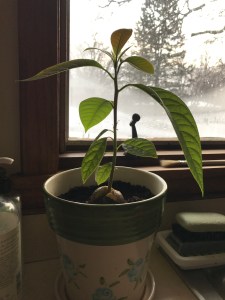
As with my avocado, it has been around six months and the thing seems to be doing just fine. I have learned immensely from it. I think it is safe to say that, even though we are both growing, I am the one deriving more benefit from cultivating this tree. Which should say a lot considering the tree would not be alive without my support. While the plant is taller and more leafy. I am more patient, more confident. I respect where my food comes from. I understand that the goal is not to “make it.” But rather to become it. To grow into whatever you deem worthy. Becoming. This is the wisdom of growing plants.


If you like this content, feel free to share it. You can also engage with me on Twitter @paulrhobus, or email me at hobus.paul@gmail.com.






 Again, look at how then Vice President Richard Nixon and Soviet First Secretary Nikita Khrushchev discussed the differences between capitalism and communism in their famous “Kitchen Debate.” This event is actually on film and can be watched
 ” Professor of Psychology Carol Dweck talks about how the mentality of an individual is either fixed or growth oriented. This process of growing a plant can unlock a growth mindset in us. When someone sees a tiny seed become a beautiful tomato stalk and bear fruit, it awakens a curiosity in themselves that maybe they too, are capable of growth. The cultivation of plants pushes the mind towards a growth orientation. (By the way I highly recommend Professor Dweck’s work so check out
  Paul Hobus